
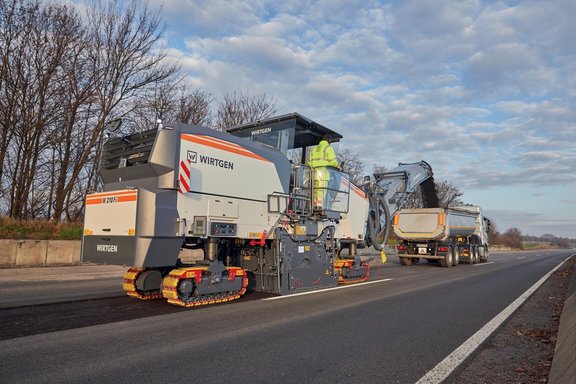
When planning a milling job, the first question you’ll ask is: how much does a Wirtgen milling machine cost? We know it’s tempting to look for a straightforward price tag, but the reality is more nuanced. The outright cost and rental rate of a Wirtgen milling machine can vary depending on model, job scope and duration, and location. Rather than a basic sticker price, we’re looking at what your investment will get you and what sets Wirtgen milling machines apart from the competition.
Find Your Nearest United Construction & Forestry
Entry-Level and Small Millers
- Power & Footprint: 60 to 200 horsepower; 10,000 to 33,000-lb operating weight; 14-47” milling width.
- Performance: Milling depths from 4-12 inches. Ideal for surface removal, localized repairs, and pavement preparation.
- Ideal For: Smaller crews, lighter site prep, short-term urban milling.
- Value: When it comes to small milling projects, Wirtgen’s line of small millers is designed for high performance at lower capacities, making them a great way to cut costs on localized projects.
Mid-Tier and Compact Options
- Power & Footprint: 345 to 400 horsepower; ~46,000-lb operating weight; 39-59” milling width.
- Performance: 13-inch max milling depth. Offers a balance of speed and control.
- Ideal For: Municipal roads, overlay removal, airport aprons.
- Value: Compact milling machines offer a step up in daily production with upgrades like MILL ASSIST and LEVEL PRO while still being manageable for moderate crew sizes.
High-Capacity and Large Millers
- Power & Footprint: 610 to 1,010 horsepower; 62,000 to 93,000-lb operating weight; 7’3” milling width.
- Performance: 13-inch max milling depth. With advanced control systems like WIDRIVE, MILL ASSIST, and more, these machines are designed to optimize performance at high capacity.
- Ideal For: Highway resurfacing, airport runway rehab, and large infrastructure. Large milling machines offer high throughput but require larger crews, more site preparation, and haul-off logistics.
- Value: While large millers come at a higher cost or rental rate, they deliver performance that drastically improves capabilities and job site capacities, helping to reduce labor costs, rework, and more.
What Your Money Gets You
| Investment | Capabilities | Tradeoffs |
| Small Millers | Highly maneuverable in tight spaces; easy to haul; lower daily capacities | Slower advance, more passes, less ideal for heavy-duty depth or width milling |
| Compact (Mid-Sized) Millers | Better width, depth, and pace; still manageable with smaller crews and job sites | More logistics-crew size and transport; higher fuel use |
| Large Millers | Maximum output; deep milling in a single pass, advanced automation technology | Higher cost; requires larger crews with high-level experience and support logistics |
Rental Considerations
Equipment rental can be a great way to cut operating costs for short-term use. Here are a few reasons renting might be a better choice for you:
- Your equipment is under repair
- The job only requires short-term use of a milling machine
- You need help keeping up with the demand of the busy season
- You want to test out new machinery before purchasing
Check Out Our Blog: Best Cold Milling Machine to Rent
Choosing the Right Cold Milling Machine
- Short, surface-level repairs: Go with a small or compact model. The lower overhead investment and impressive throughput offer excellent value for its size.
- Mid-scale jobs and moderate depth needs: A compact model like the W 120 XTi or W 150 XFi balances cost and performance, making it a safe investment that doesn’t have to break the bank.
- Deep cuts, wide swaths, and fast turnaround: Investing in a large milling machine makes sense for high-scale projects. The high capacity results in fewer passes, less rework, and faster completion.